
Find Albany Resident Records
Albany has no single official roster of everyone who lives in the city. A useful search begins by defining the role in the record. A parcel roll identifies a tax-record owner and mailing address. A city directory records a name, address, and sometimes occupation for one edition. A deed identifies parties to an instrument. A voter portal reports a match for the information supplied. Those are different claims, and the date matters for each one.
Start with an address when the question is about a property, and start with an edition year when the question is historical. A name can then be checked against an independent source with the same place and period. Albany is both a city and the county seat, so City and Albany County records may be nearby while their custodians and coverage differ. Keep the City, municipality, and source date with every result.
- Use Albany County PROS to find a current parcel by address, SBL, owner, street, or municipality.
- Save the parcel identifier, situs, owner mailing address, and roll date before comparing any other record.
- For a historic household, consult an Albany Public Library directory for the specific edition year.
- Follow a property change in the Clerk or Hall of Records deed indexes, retaining the book and page.
- Use the proper custodian for restricted, sealed, or unavailable material instead of treating a portal gap as a negative fact.
Note: A name match becomes more reliable when two independent Albany sources share both a time period and a location.
Albany Residents Records Desks
Several Albany offices create records that help answer different resident-directory questions. The County Clerk and Hall of Records hold land, judgment, lien, DBA, UCC, court, and inactive City and County material. City Assessment maintains the current assessment route. The Albany Public Library preserves the local directory shelf. The County Board of Elections handles voter resources, while the state portal handles an individual voter match. Each office has a separate access channel when the web result is incomplete.
Albany County Clerk / Hall of Records
Land records, court filings, archives, and genealogy research
City of Albany Assessment
Current and tentative assessment rolls
Albany Public Library
Directories, maps, newspapers, photographs, and clippings
The Clerk has an online route through SearchIQS, but earlier chains can require the Clerk or Hall indexes and record books. The Library’s Local History Room is by appointment, and staff can retrieve directory volumes when the room is closed. These offline routes matter because a missing web result does not mean the archive has no relevant record.
Search Albany Residents Through PROS
PROS is the practical starting point for an Albany address or current parcel. It accepts a street address, tax map number or SBL, and an owner name. Its Street Finder lists public roads, and the municipality selector keeps a countywide result from being mistaken for Albany City. An owner result can be a corporation, estate, or remote owner, so it is a property record rather than proof of who occupies a home.
| PROS field | Input type | How Albany uses it |
|---|---|---|
| Street Address | Optional text | Enter number and name, omitting the Street, Road, or Lane suffix. |
| Tax Map # / SBL | Optional text | Connects a tax bill or assessment roll to the parcel. |
| Owner Name | Optional text | Searches current or prior owner names; the portal documents exact-prefix behavior. |
| Street Finder | Optional dropdown | Browses properties along a selected public road. |
| Municipality | Optional dropdown | Separates Albany City from other Albany County places. |
PROS advanced search adds neighborhood, street, owner, property-class, sale, size, assessment, and condition filters. It did not display a dedicated ZIP field in the inspected interface. Treat sale data carefully because the portal notes that a sale price is not necessarily an arm’s-length transaction.
The PROS quick-search screen shows the address, SBL, owner, Street Finder, and municipality choices used for an Albany residents directory search.
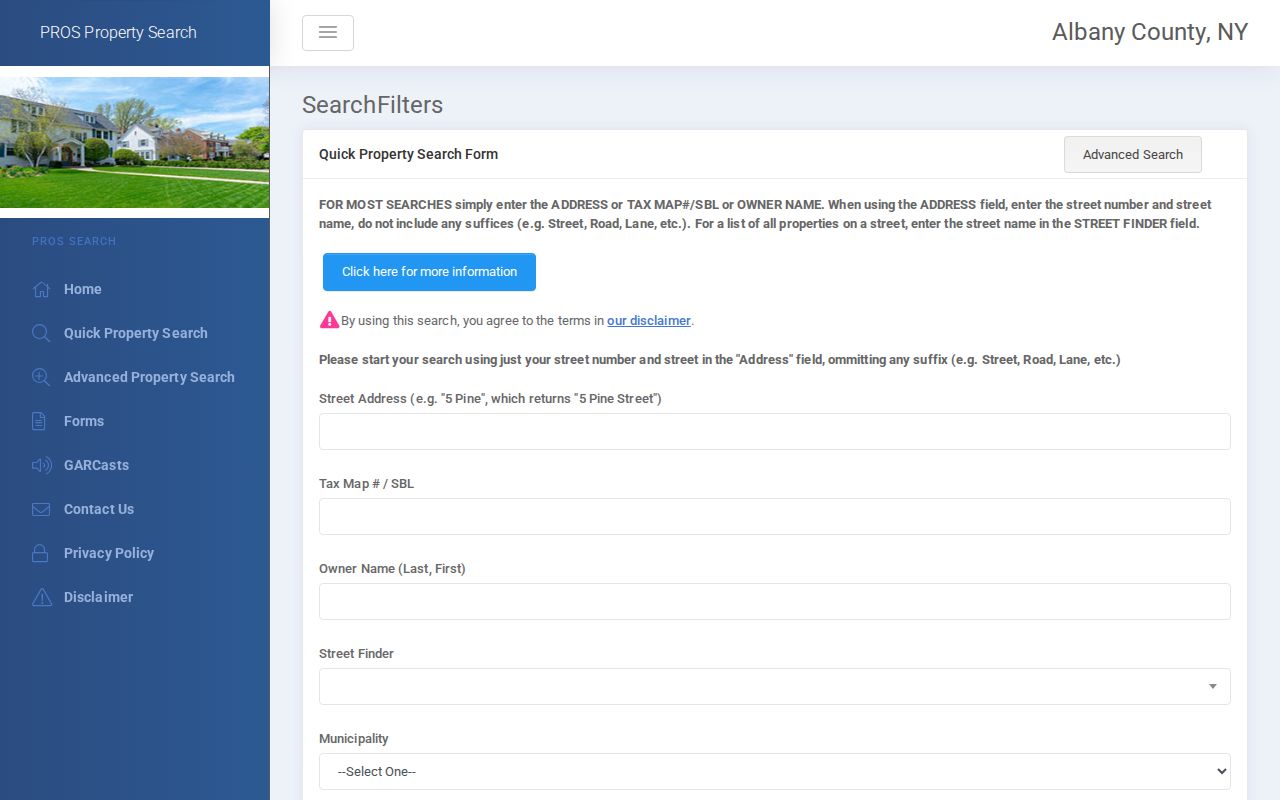
Those fields make the search reproducible and help separate a street name from a tax-map identifier.
Albany Residents and Parcel Context
The City’s MapGeo viewer is a place-based companion to PROS. Search a property or address, click its polygon, and record the parcel/SBL, situs, owner mailing field, class or value, and data date. Clicking adjoining polygons provides a tightly defined block view. Map themes can add historic district, zoning, green-space, Council district, neighborhood association, trash-day, and police-engagement context.
MapGeo’s inspected City parcel boundaries and property information carry older data dates, so the current assessment roll should take priority for a current value or ownership question. The County ArcGIS public layer is also illustrative rather than a resale product. A parcel geometry can locate a record, but it does not identify every person at that location.
Current Albany Resident Directories
Current Albany resident directories are best understood as purpose-built records, not a general people list. The sources below have different reach and different limits. They are useful for civic transparency, property history, estate work, reconnecting with a documented historical contact, and checking a public claim. A result should retain its source date and record type.
| Albany source | Record role | Custodian | Route |
|---|---|---|---|
| PROS or City assessment roll | Tax-record owner, situs, and mailing data | County RPTSA / City Assessment | Online roll and property portal |
| SearchIQS recorded index | Grantors, grantees, and instruments | Albany County Clerk | Online index plus Clerk/Hall holdings |
| NYS voter lookup | Registration or poll-site match | State elections system | Identifier-based online match |
| Local directories | Printed name/address snapshot | Albany Public Library | Room, microfilm, digitized volumes |
| Public entity or license records | Official business or credential connection | NYS DOS / NYSED | State search portals |
When the question concerns one named person rather than a property or directory year, compare dated results through the Albany resident lookup workflow instead of combining unrelated role labels.
Albany Voter Lookup Boundaries
New York’s voter tool is a match service, not an Albany resident list. The public-facing form requires County, last name, first name, date of birth, and ZIP. Its returned information concerns registration, poll site, or ballot status after the supplied conditions match. A ZIP can be a mailing or institutional code, and the inspected form did not offer a separate full-street-address field.
NYS Poll Site Search, Voter Registration, and Mail Ballot Tracker should be used only for the task it performs. Public election records also have use limits under Election Law §3-103(5), and confidential voter protections apply. Historical Albany research follows a different route: the Hall of Records lists voter enrollment for 1941–1969 and registers for 1899–1966, with ward context for earlier work.
Albany Resident Court Record Context
A court party name can help distinguish an identity only when court, county, case number, date, and documents match the question. NYS eCourts provides a statewide entry point, while WebCivil Local, WebCivil Supreme, WebFamily, and NYSCEF serve different matters. NYSCEF’s documented searches include case identifier, party name, tax cert/SCAR, new case, and narrowed court or date searches.
Sealed, confidential, delayed, future, paper-filed, and nonparticipating matters may not appear. Court records are governed by court rules and Judiciary Law, not an ordinary FOIL request. A no-result display tells only what that portal and search window returned. For a copy or an unindexed matter, contact the correct clerk rather than drawing a conclusion from a broad name search.
Note: A case caption can name an attorney, witness, creditor, or similarly named party, so it is never a standalone residence record.
Historic Albany Residents Directories
The Pruyn Collection at Albany Public Library holds nearly complete Albany City Directories from 1813 to the present. The Local History Room also holds maps, newspapers, photographs, clippings, yearbooks, and microfilm. The volumes are noncirculating. Directories from 1813–1950 are available through the Reference Desk, while 1950–present volumes are available when the Washington Avenue Branch is open. The full historical shelf and its formats belong to the Albany city directory collection page.
A directory is an annual snapshot. Record the edition, publisher, page, exact spelling, address, occupation, and any notation before comparing it to a deed, assessment, newspaper, or census entry. The Hall of Records has City directories from 1830–1994, business listings from 1857 onward, and street guides from 1914 onward. It provides an in-person or appointment route and mail research at the documented hourly rate.
- Roll
- An official list or assessment record made for a defined administrative purpose and date.
- Index
- A finding tool that points to a record; it is not always the source document itself.
- Parcel
- A taxed piece of land identified by a map or SBL number.
- Criss-cross directory
- An address-first house or street directory that helps move from a number to a name.
Albany Directory Years Matter
Albany’s format changes are useful research clues. The first street directory appeared in 1872. House directories begin in 1895H/1896H, resume in 1914, and gain cross streets in 1914. House and street material merges in 1932, and from 1943 the combined guide is called a Street and Avenue Guide or Street Directory. Ward numbers appear in street guides from 1897–1965, while ZIPs per street begin in 1967.
Early editions also used conventions that should be preserved as source metadata. African American names were italicized in directories from 1815–1853, and 1834–35 used an asterisk. Death notations occur frequently after house-directory names from 1881H to about 1960, though the Library guide does not identify their source. These are editorial practices, not a complete demographic or vital-record index.
Trace Albany Residents Through Deeds
The Albany County Clerk holds deeds and mortgages from 1630 to the present. SearchIQS generally supplies deeds and mortgages with index and images from 1980 forward. Older online tiers are partial: grantor deed indexes cover 1922–1979, grantor corporations 1940–1979, and deed record-book images run from October 1908 to January 1980 for books 581–2181. Earlier research moves to Hall of Records grantor/grantee indexes and deed books rather than stopping at an online gap.
Start with the current parcel, record its deed book/page and legal description, then search the current grantee. Read the instrument image when available and follow the prior grantor backward. A mortgage, lien, assessment owner, and occupant are not interchangeable roles. Older material can be offsite and may take 24 hours to retrieve, so the Clerk and Hall remain part of the documented access chain.
Albany Resident Vital Record Windows
Vital records answer an event question, not a general location question. Albany City Vital Statistics holds City birth and death events beginning September 1, 1870. City genealogy access begins after 50 years for deaths and 75 years for births when the person is known deceased. A direct-line applicant may request a waiver with proof of death, relationship, and photo identification. Recent certified copies are restricted and are not FOIL records.
The City’s genealogy route has its own forms, payment rules, and typical six-to-eight-week processing. New York State Department of Health guidance has a statewide route for most non-New York City events, with its own genealogy periods and an eight-month-or-longer search warning. The State Archives holds selected indexes rather than original certificates. Albany City marriages at the Hall have differing published endpoints, so preserve the exact source and date range used instead of treating them as one certain range.
Note: Before ordering, confirm the event municipality, record type, year, applicant eligibility, and whether the City or State is the custodian.
Albany Residents Need Municipality Checks
An Albany mailing address or ZIP does not always mean the City of Albany. Albany County includes three cities, nine towns, and six villages. ZIPs are delivery geography, while a parcel’s municipality, a neighborhood label, a ward, a school district, and a census tract are separate systems. USPS should validate the actual address and ZIP; the assessment or PROS record should establish municipality.
The City’s materials specifically caution that portions of 12204 and 12205 extend outside City limits. County health-report groupings connect North Albany and Menands with 12204 and Loudonville with 12211, but those are report groupings rather than postal boundary maps. Record each geography separately when it appears in a source.
Albany Records Requests and FOIL
When an existing City or County record is not online, use the appropriate custodian’s request route. Albany City Records Access and FOIL identifies City request categories. New York FOIL, Public Officers Law Article 6, governs many executive-branch records, but it does not require an agency to create a new directory or disclose an exempt field. Court, voter, and vital records have their own access rules.
The image below shows the City’s official FOIL route. A clear request identifies the record, date range, office, and usable format. It should not demand a sensitive list that the agency does not maintain or may not disclose.
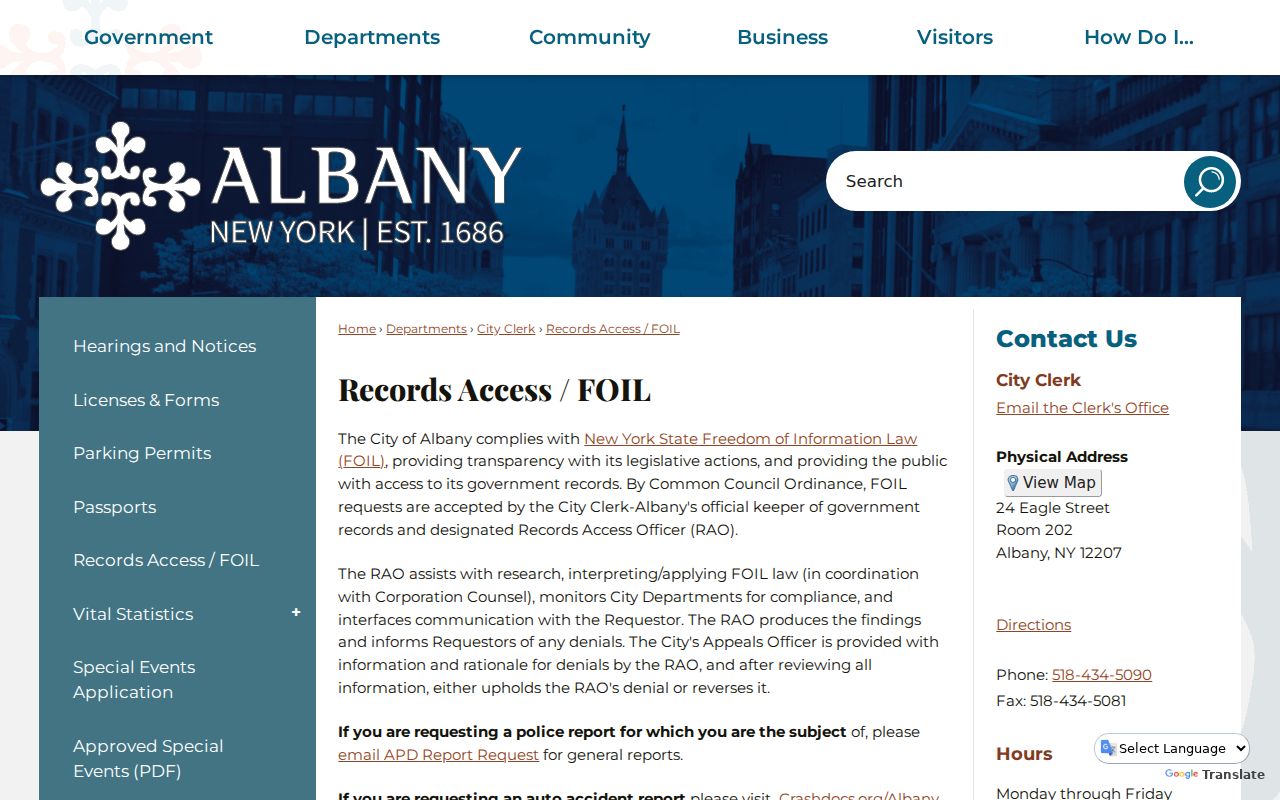
Using the custodian’s form preserves a direct record trail and makes it easier to understand any exemption or partial release.
Protect Albany Resident Addresses
New York’s Address Confidentiality Program gives eligible participants a substitute address and requires state and local agencies to safeguard the actual location under Executive Law §108. Participation itself may be verified, but a physical address is protected. Confidential voter procedures, restricted vital records, sealed court matters, and motor-vehicle privacy rules create similar limits. A missing field can reflect protection, not a research puzzle to solve.
Use the minimum information needed for a lawful historical, estate, civic, or property inquiry. Keep source year, municipality, record type, and citation. Do not republish current phone numbers, dates of birth, protected status, apartment details, or a private individual’s current address. The safest conclusion is narrow: state what the dated record says and what it does not establish.
Cite Each Albany Resident Result
Albany’s strongest research trail is a three-way comparison: a Library house or street directory for a historical person/address snapshot, a City or County parcel record for a property identifier and roll date, and a Hall of Records deed, map, permit, or tax source for legal or physical continuity. Each source has a different job. None should be silently upgraded into proof of present occupancy.
For every result, preserve the custodian, source URL, edition or roll year, page or instrument number, municipality, and retrieval date. Record any coverage gap as a gap. That discipline turns a collection of names into a checkable Albany residents directory record trail.