
Albany Resident Lookup Record Coverage
No single roll in Albany confirms where every person lives. A resident lookup works by weighing records that each carry a piece of the answer. The Albany County PROS parcel search ties a tax-record owner to a mailing address. Albany Public Library directories can place a person at an address in a given edition. New York court services may add public case context. Vital-record and voter routes carry stricter rules, though. Match the source to your question, and note the date of any result.
| Record | What It Confirms | Where | Access |
|---|---|---|---|
| Property roll and parcel record | Tax-record owner, mailing address, property location or situs, class, and parcel identifier | Albany County PROS and City assessment records | Public portal and annual roll; owner is not automatically the occupant |
| City and house directories | Name, address, occupation, or household notation for a published year | Albany Public Library Local History Room | Nearly complete 1813 to present collection, with room and desk access rules |
| Recorded deeds | Grantor, grantee, legal description, and recorded ownership trail | Albany County Clerk SearchIQS and Hall of Records | Online index and images generally 1980 to present; office route reaches earlier material |
| Voter and poll-site match | Portal match for supplied registration conditions | New York voter lookup | Identifier-based service, with confidential records protected |
| Court filing | Public case or document context tied to a court, county, and date | NYS eCourts and NYSCEF | Portal and clerk routes; sealed and limited records are not returned |
| Vital or genealogy record | Eligible historical event or genealogy search result | Albany City genealogy service, NYS DOH, and Hall of Records | Restricted by event place, age, relationship, and copy type |
Reach for a historic directory first when the clue is an old address or year. Turn to PROS when a parcel is known. Any court or license hit deserves a second Albany source before you trust the match. For whole-street questions, take a different path. The Albany Street Directory follows an address-first record chain instead of a name-based workflow. That order of operations saves time.
Anchor an Albany Resident Lookup
A solid Albany match starts with a non-sensitive anchor. Full name, approximate year, a street, a historic occupation, or a public entity tie all work. Record the middle initials, suffixes, married or widow forms, entity names, and apartment or floor. Add the municipality, ZIP, and the source date. Albany mailing addresses can point to the city, a county town, a state-agency code, or a nearby place. So a parcel SBL, the tax-map identifier, or a legal description beats a city name alone.
Pair the first result with an independent record from the same era. A directory entry can stand beside an assessment roll. A deed, a newspaper item, a license record, or a court document also works. Never join a current tax mailing address to an old directory listing. Do not call it a present residence. Owner, occupant, voter, party, licensee, business officer, and decedent are distinct record roles. Each role answers a different question. Confusing them is the fastest way to a false match.
Albany Resident Lookup Court Fields
New York's court portals split their coverage by court and case type. WebCivil Local, WebCivil Supreme, WebFamily, NYS eCourts, and NYSCEF each serve a different slice of the docket. Albany County Court, Albany Supreme Court, Surrogate's Court, Family Court, and the City courts handle separate matters. So the right portal depends on the case. A name hit alone proves little. County, court, case number, date, and document context all matter. An Albany resident lookup can rely on it only then.
The NYSCEF case-search help page spells out the actual search modes. It also shows the fields each mode returns. Treat these portals as a way to confirm a public case. They are not a tool for building a personal profile of a neighbor.
| Case Identifier | Case number, attorney file number, or third-party index number. This searches an NYSCEF identifier, not every paper-filed court case. |
|---|---|
| Name | Business or organization name, or first and last name with an optional middle name. Confirm case type and party role. |
| Tax Cert/SCAR | Block and lot text fields for tax assessment challenge filings. |
| New Cases | Court selection and filing date controls to narrow recent e-filed cases. |
| Narrow Search | County, case type, date range, and other mode-specific controls for participating civil e-file records. |
The official NYSCEF help page displays the search modes shown in the court image.
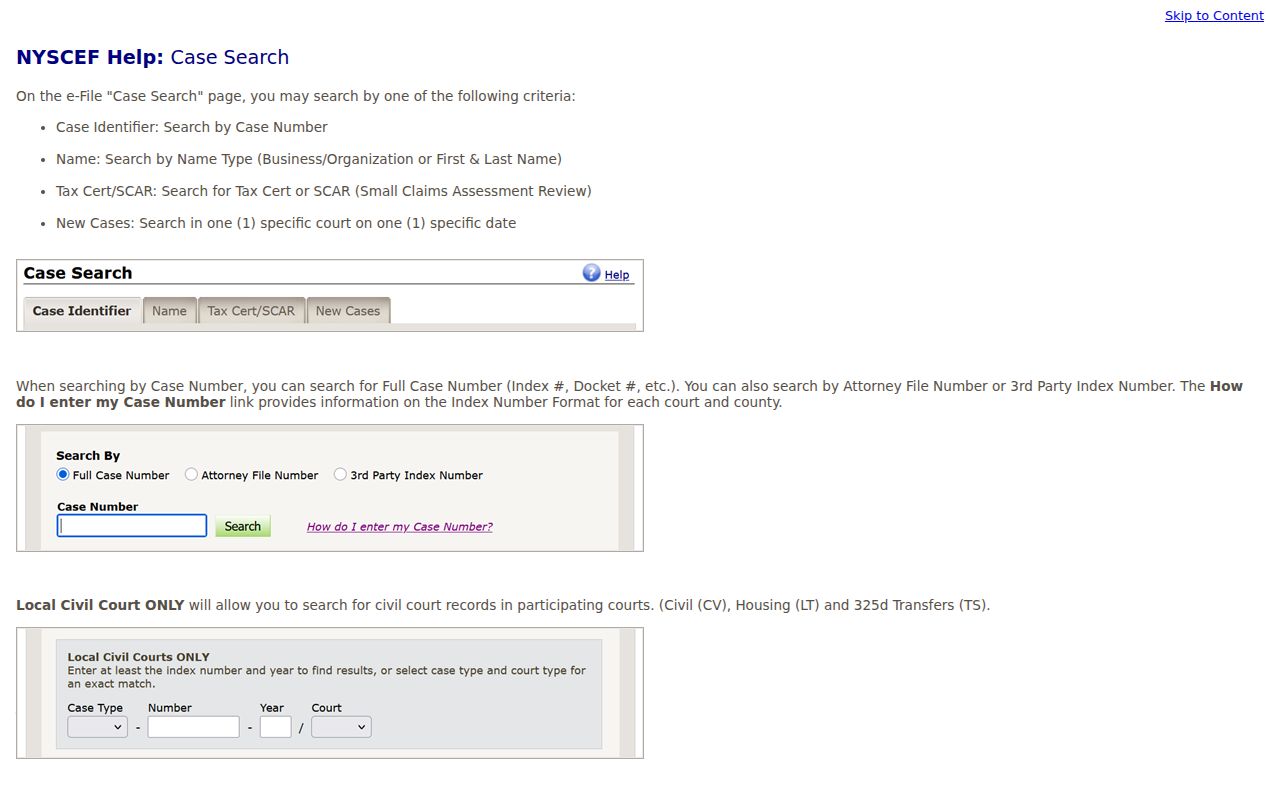
Some case records stay out of view. Sealed, confidential, delayed, future-dated, youthful-offender, adoption, guardianship, and certain Family Court materials can be absent or limited in any Albany search result. Copies of court records follow Judiciary Law and court rules, not the ordinary Albany FOIL process used by other offices.
New York Voter Fields for Albany
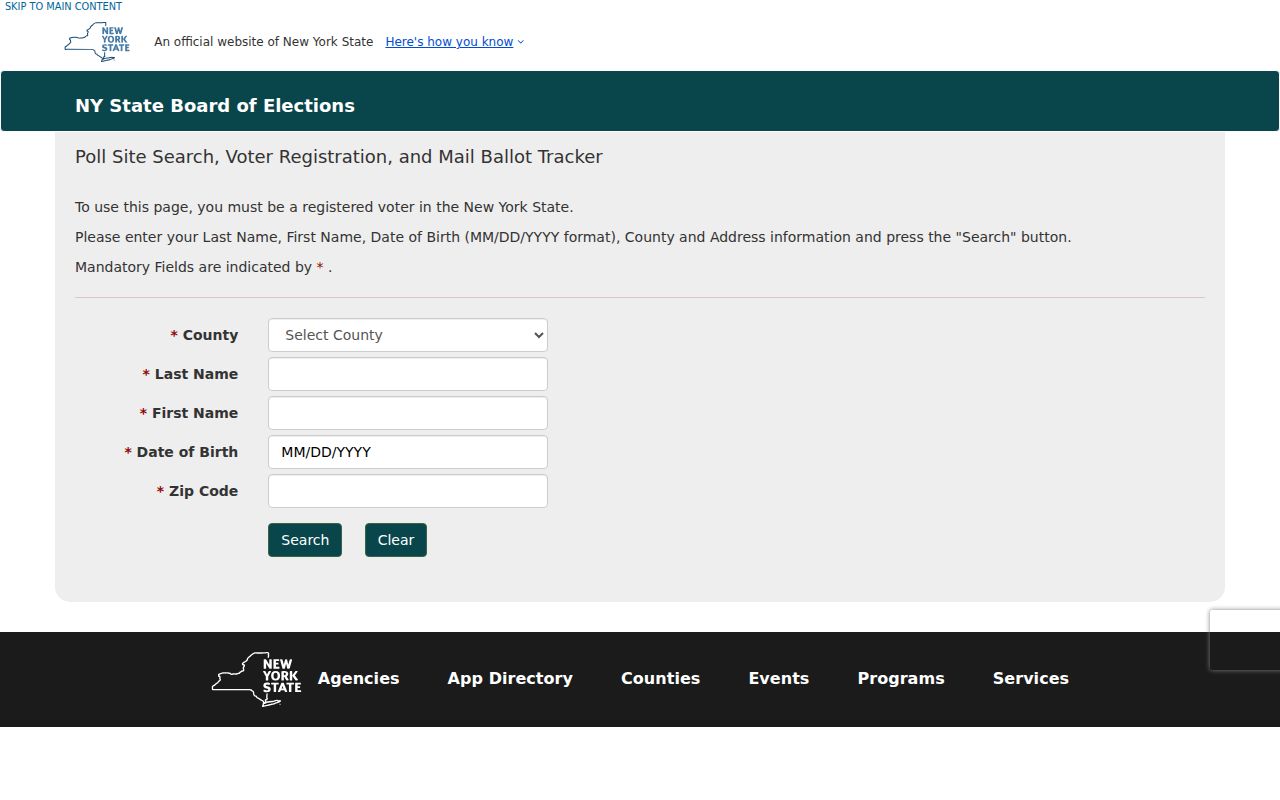
The New York Poll Site Search, Voter Registration, and Mail Ballot Tracker works by condition matching. Enter details that fit a registration record. The portal then returns that record's polling information. It is not an open Albany voter list for browsing. New York also restricts non-election uses of voter data. The record set has real limits. A returned screen is best described as a portal match for the conditions entered.
The official voter lookup shows exactly which fields the form asks for.
| County | Required select field. Choose Albany to set the Board of Elections jurisdiction. |
|---|---|
| Last Name | Required text field for the registration-name match. |
| First Name | Required text field for the registration-name match. |
| Date of Birth | Required text field in MM/DD/YYYY format. It helps distinguish people with the same name. |
| ZIP Code | Required match and location field. A ZIP may be a mailing or institutional code. |
| Search | Returns poll-site, registration, or ballot-tracker information when a match exists. |
The New York voter service is shown in this Albany resident lookup image.
Older Albany voter material lives elsewhere. The Hall of Records holds enrollment lists from 1941 through 1969 and voter registers from 1899 through 1966. The current portal answers today's questions; the archival series answers the historical ones.
Verify an Albany Resident Record
Treat verification as a sequence with dates. A name alone proves nothing. Anchor it first to a time and place with one source. Then overlap that same window with an independent record. For common Albany surnames, add a third source before trusting the match. Record the exact edition, instrument, roll, case, or index number. A screenshot is weaker than the identifier itself.
- Write down the full name, a known year, the municipality, and any street or public role. Search spelling and name-form variants without merging people merely because they look alike.
- Use an Albany directory, PROS result, or deed index to establish one dated address or parcel reference. Label whether it says owner, occupant, grantee, or another role.
- Find an independent source that overlaps the same year or period, such as an assessment, deed, newspaper, public court document, license, or census record.
- Compare the location, middle initial, party role, parcel SBL, or record identifier. If the points conflict, retain both dates and do not force a conclusion.
- Request the original or certified item only from its custodian when proof is needed. The County Clerk, Hall of Records, court clerk, City registrar, and NYS DOH each hold different records.
- Docket
- A court’s organized case record, usually keyed by a case or index number and containing filings, dates, and status information.
- Index versus image
- An index helps locate a record by name, number, or date. The document image is the underlying filed or recorded item and may have separate access rules.
- Certified copy
- A copy issued or certified by the legal custodian for an authorized purpose. It is different from a search screen or plain reference copy.
Albany Resident Lookup Vital Rules
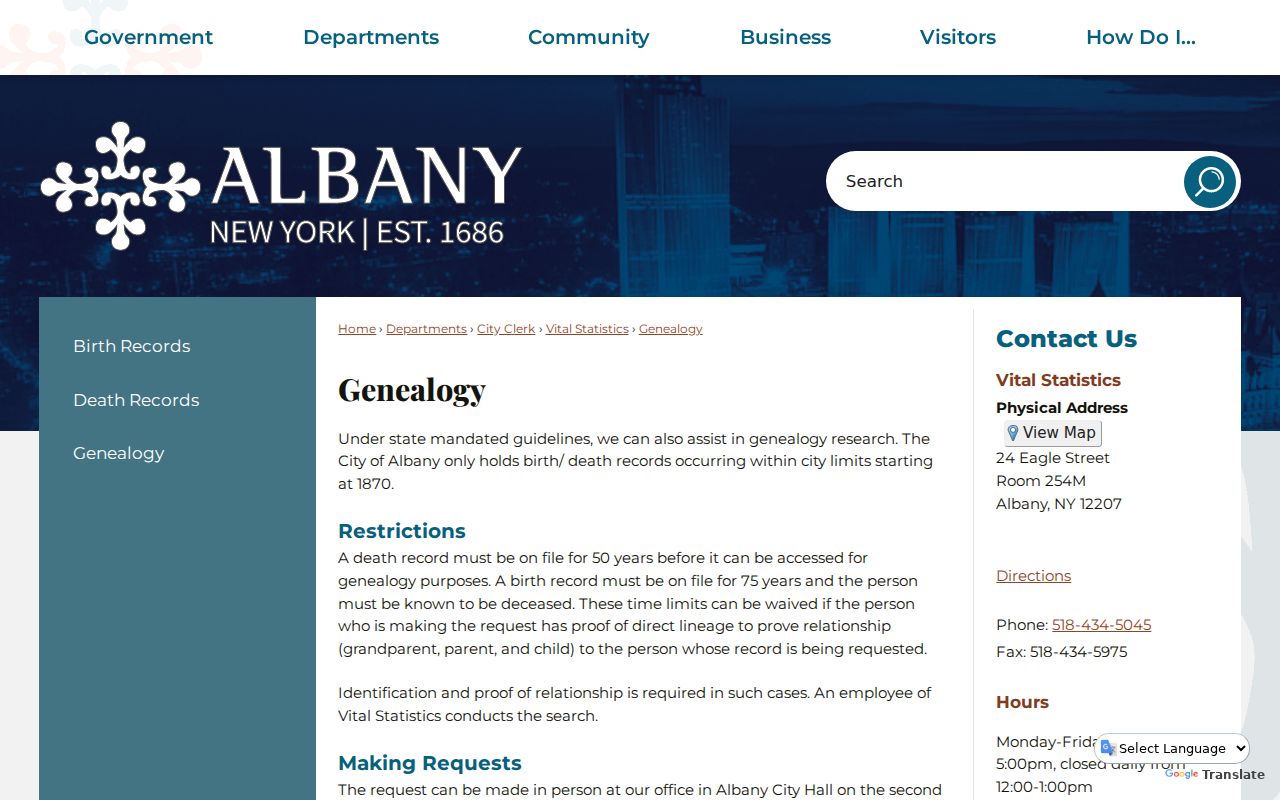
Albany City Vital Statistics keeps city birth and death events from September 1, 1870 forward. These files are not open to public inspection. Genealogy access opens after 50 years for deaths. Births open after 75 years, once the person is known to be deceased. A direct-line applicant can seek a waiver. The waiver needs proof of death, proof of relationship, and photo ID. Recent certified copies go only to entitled applicants.
For events outside Albany city, or for statewide reach, the New York State Department of Health route applies when its jurisdiction fits. The Hall of Records also holds historical City marriage and genealogy material. Its published marriage end dates differ by guide, so check them before relying on one figure. Where the Hall index requires it, search by bride first. Then confirm the groom, the date, and the original record. Mail research through the Hall runs $20 per hour with a one-hour minimum. An optional written certification costs $4.
The Albany City genealogy page lays out the local eligibility rules and request process.
Match the office to the record before you search. City events belong to the City registrar, statewide material to the State Department of Health, and older historical files to the Hall of Records. Each custodian holds a different slice of Albany's past. A no-record reply often means the jurisdiction was wrong or the search was too narrow, not that the person never lived in Albany.
Albany Court Result Inventory
An Albany court result earns its value only when its identifying fields travel together. The court and county fix the jurisdiction. The case number pins down the file. Party role and caption are what keep an attorney, creditor, or witness from being mistaken for the subject. They also rule out an identically named stranger. When an image is public, NYSCEF adds document-level fields on top of those basics.
| Field | What to Preserve |
|---|---|
| Case identity | Case or index number, court, county, case type, filing date, caption, and party names and roles. |
| Case status | Judge, appearance or calendar date, status or disposition, and any sealing or confidentiality indicator. |
| Document detail | Filing or document number, document type, filed date and time, filer, party association, and public-image link when displayed. |
| Retrieval context | Portal, exact search path, county filter, query date, and any limit reported by the portal. |
Published decisions can round out an Albany court search. The decisions database reaches back to 2001, but it is not a full docket. For status and copies, rely on WebCivil or the relevant clerk.
Albany Dates That Change Matches
Coverage dates change what a negative search means. Albany Public Library's city-directory collection opens in 1813. The first street directory arrived in 1872. House directories began in 1895H and 1896H, paused, and resumed in 1914, the same year cross streets first appear. SearchIQS generally covers deed and mortgage indexes and images from 1980 forward, while older chains still require the County Clerk and the Hall of Records. Albany City vital custody starts in 1870.
These dates are working tools, not trivia. They point a researcher toward the right custodian next. The Library's house-directory death notations run frequently from 1881H to about 1960, but the guide never names its death-date source, so treat each notation as a lead rather than proof. Do the historic directory work in the Albany City Directory collections first. Pair it with a modern record afterward.
Privacy Limits for Albany Resident Lookup
New York's Freedom of Information Law, or FOIL, lets you request an existing City or County record. It cannot force an agency to build a resident list or hand over exempt material. Court records answer to Judiciary Law and court rules. Vital records carry eligibility limits. Election material opens only in defined ways, and Election Law bars non-election use of voter data. DMV-derived personal information is restricted too.
New York's Address Confidentiality Program gives eligible participants a substitute address while the real residence stays confidential. Confidential-voter procedures shield still more records. Never infer a physical address from a missing result, an old listing, a substitute address, or map clues. If the next step leads to a sealed record, a protected address, restricted vital data, a non-public database, or a sensitive current location, stop. Contact the official custodian instead.
Lawful use. Use Albany records for personal, lawful research and preserve only the fields needed for that purpose. Never use a result to stalk, harass, intimidate, or harm a person.