
Albany Previous Residents by Era
The backward trail for previous residents begins with the era in question. Albany County property records can connect a current parcel to earlier deeds, but deed ownership and household presence are not the same thing. Albany's city and house directories fill some of the years between transfers. Tax rolls, permits, maps, and archival material can help test whether the same physical place is being followed when an address or street wording shifts.
Use the source that is closest to the date being researched. A recent transfer often starts online. An older chain may need a book/page, an index volume, or a Hall of Records request. A directory or map should be cited by its own edition or map year, not used as a substitute for a recorded deed.
| Source | Years It Covers | Where Held | What It Shows |
|---|---|---|---|
| Deeds and mortgages | 1630-present in office; online deed images generally 1980-present | Albany County Clerk / Hall of Records and SearchIQS | Grantors, grantees, recording details, legal descriptions, and book/page references |
| Deed index books and record books | Grantor 1922-1979; grantor corporation 1940-1979; deed images 1908-1980 | SearchIQS coverage and Clerk/Hall routes | Bridges between current online documents and earlier deed research |
| Albany City Directories | Nearly complete 1813-present | Albany Public Library Pruyn Collection; listed digital and archive routes | Printed name, address, and other edition-specific entry details |
| House and street directories | 1895H/1896H; 1914 onward; merged in 1932 | Albany Public Library and Hall of Records | Address-first and street-order entries, with cross streets in the later run |
| Tax rolls, permits, and maps | Tax rolls 1813-1976; permit index 1909-1925; maps from 1857 | Hall of Records and related City records | Annual property status, physical change, and historic street or building context |
Note: An Albany source can identify an owner, a printed address entry, or a map feature without proving a continuous household history.
Anchor an Albany Address First
Start with the address as it exists now, then obtain the parcel or SBL from Albany County PROS or the City assessment roll. Record the physical situs, owner mailing address, municipality, current owner name, assessment year, deed book/page, and property class as separate facts. Albany County includes three cities, nine towns, and six villages. An Albany, NY mailing label does not by itself establish the City of Albany as the parcel municipality.
This anchor is important because a street name or number may change while the legal description continues through the deed trail. The current roll prints owner address and property location as different fields. A corporation, estate, trust, or out-of-town owner can produce a mailing address unrelated to the physical place. Keep the original source date with the SBL, rather than carrying a current value into a past-resident statement.
Albany Deed Records Before SearchIQS
SearchIQS is a useful online door, not the full Albany deed trail. The County's stated office coverage for deeds and mortgages reaches from 1630 to the present, while SearchIQS generally provides deed and mortgage indexes and images from 1980 forward. For earlier dates, SearchIQS lists deed index books for grantors from 1922 through 1979 and for grantor corporations from 1940 through 1979. Deed record-book images cover October 20, 1908 through January 4, 1980, books 581 through 2181.
Before those online ranges, move to the Albany County Clerk / Hall of Records indexes and books. The Clerk says older material may be offsite and can require up to 24 hours for retrieval. That is a normal access step, not evidence that a prior owner or past resident did not exist. Bring the known parties, approximate date, legal description, and book/page to make an archive or counter request specific.
SearchIQS Albany data availability records the current document-type and older-book coverage used to plan a backward search.
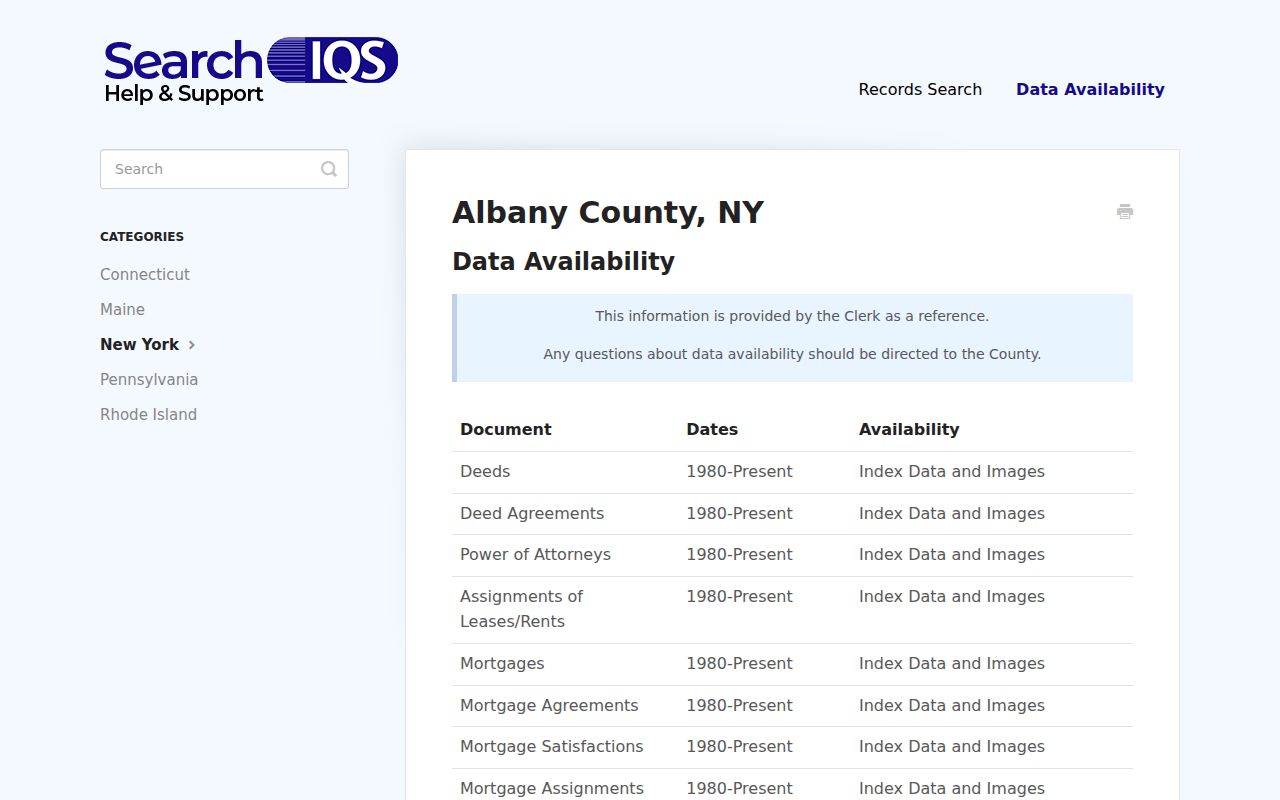
The coverage screen helps choose the next route, whether that is an indexed image, a deed book, the Clerk counter, or a Hall of Records search.
Trace Albany Previous Residents Through Deeds
Follow the chain of title backward from a confirmed parcel. The goal is to identify the prior transfer and its legal description, not merely to search the present street name again. Each deed can name a grantor, who transfers an interest, and a grantee, who receives it. That sequence often links the seller in a later deed to the earlier owner record. Preserve spelling variants, estate or corporate forms, and the exact party role.
- Pull the current parcel, SBL, municipality, situs, owner mailing address, and deed book/page from PROS or the assessment roll.
- Search the current grantee in SearchIQS with the recorded book/page, address, or legal description when available.
- Open the deed image and record its grantor, grantee, document date, recording date, legal description, consideration when displayed, and prior instrument reference.
- Search the prior grantor as the next historical grantee, using name variants and the legal description to distinguish same-name parties.
- Continue backward through the online coverage, then use the Hall's public grantor/grantee indexes and deed books for the earlier period.
- Ask the Clerk or Hall for the next record when a book, page, or approximate date points to offsite material.
- Grantor
- The party who transfers an interest in a deed.
- Grantee
- The party who receives that interest. A later grantee can become the next prior owner to search.
- Chain of title
- A dated sequence of recorded transfers tied together by parties, book/page references, and legal descriptions.
- Legal description
- The parcel wording in a deed. It can connect records when an older street number or name is different.
Note: Preserve each party's role and document date because the same name can appear in several unrelated Albany deed entries.
Albany Grantors, Grantees, and SBLs
Deed research works best when the parcel identifier and legal description stay ahead of the street label. An SBL is the government parcel or tax-map identifier used by the roll. It is often the stable key that links a modern assessment record to an instrument that uses a subdivision, lot, metes-and-bounds, or book/page reference. The legal description and exact municipality help avoid joining two people with a common name.
SearchIQS exposes an index-and-image workflow. For every returned entry, record the instrument type, document number if shown, recording and document dates, parties, property or legal description, municipality, SBL when present, book/page, image indicator, exact query, coverage tier, and retrieval date. A mortgage, satisfaction, lien, or judgment can add property context, but it is not a deed. A tax owner also is not automatically the historical person at the address.
Albany County Clerk services include in-person self-search without a search fee. A pre-1980 Clerk search can carry a $5 fee. For paid copy or search work, mail or visit with the correct payment because email and fax requests are not accepted when payment or copy fees must accompany the request.
Albany Directory Years Between Deeds
Deeds describe ownership intervals. The household layer often comes from dated directory material. Albany Public Library's Pruyn Collection holds nearly complete Albany City Directories from 1813 to the present. The Local History Room is by appointment, and staff can retrieve directories when it is closed. Directories from 1813 through 1950 are available through the Reference Desk; the 1950-present volumes are available while the branch is open.
House directories are the address-first route. They begin in 1895H and 1896H, resume in 1914, add cross streets in 1914, and merge into the street directory in 1932. A general directory runs the other direction from name to address. Its collection details are retained on the Albany city directory page; for an address history, use the appropriate edition to fill a dated gap between recorded transfers rather than treating the collection as a current list.
The library also identifies microfilm and print runs, a New York State Library microfilm route, 86 digitized years across several repositories, and Ancestry Library access at APL computers or Wi-Fi. These alternatives matter when a needed edition is not on an open shelf or in one web repository.
Albany Maps Explain Address Changes
Maps and permits explain the physical history around an Albany address. The Hall's address guide cites Sanborn Insurance Maps for 1892, 1908-09, 1934, and 1972-74, plus the G.M. Hopkins 1876 Atlas and the Beers 1866 atlas. These sources can show a building footprint, street form, materials or use in their map year. They do not establish the people who were there.
The Hall also lists the 1909-1925 building-permit index, water rents from 1851-1972, street-opening files, photographs, and inactive records. A missing street-opening file is not proof that a street was never altered because the Hall warns that not every street has one. Test a former name, ward, cross street, parcel, and legal description before treating a changed address as a broken trail.
Albany has 16 local historic districts and four nationally recognized districts according to the City preservation material. An historic-district overlay can help locate map or photo context, but it does not identify a past household by itself.
Note: Map and permit dates explain physical change, but their context never replaces a dated Albany address record.
Albany Previous Residents and Census Timing
Use a simple dated flow for people who lived at an address before: address and parcel, then deed interval, then house or street directory, then a census or newspaper source appropriate to the same period. A directory records one printed edition. A census is another dated household source. Neither should be used without its date, geographic context, and the exact address form or cross streets that connect it to the property trail.
- Start with the closest directory edition and copy the address, name, occupation line if printed, section, and page.
- Compare the entry with the surrounding directory years to see whether the address or street label changed.
- Use the matching census period, where available, as a separate household check rather than an address substitute.
- Check Albany newspapers, clippings, photographs, and maps for dated context, recording the title, issue date, and page for each result.
- Return to the deed or tax trail when a name, number, or legal description conflicts.
APL's house-history FAQ recommends beginning with address listings in city directories, using a first appearance only as a rough build-date clue, and adding Hall deeds, maps, permits, library photographs, newspapers, and clippings. A newspaper notice or obituary needs its publication date and title, and is not a civil certificate.
Albany Court and Probate Context
Estate or court material can sometimes explain why a deed names an estate, executor, corporation, or other party form. It should be handled as a separate record trail. Albany County Clerk office coverage lists court records from 1793 forward, while modern NYS eCourts and NYSCEF are selective and portal-specific. A court index can identify a case or party, but it does not establish a prior address or household history.
For older family context, the Hall of Records holds city directories, census, naturalization, marriage, grantor/grantee indexes, and City and County inactive records. Staff assist in person or by mail at the Hall, which is at 95 Tivoli Street in Albany. Mail research is $20 per hour; on-site copies are 50 cents per page and written certification is $4. Its archival holdings are noncirculating, so a counter or research request may be the only route for a particular item.
Note: Keep court, deed, directory, and archive findings in separate dated entries, because each source records a different legal or historical role.
Limits on Albany Previous Residents
A backward address trail can contain gaps. Historic sources may use a former street name, an unnumbered building, a changed index method, an omitted apartment, or a noncirculating original. A directory entry can reflect a move, a printed convention, or a business address. A parcel roll can identify a tax owner without naming the people present there. The careful conclusion is that a specific source located an entry for a specific date.
Do not infer a current location from a historical find, or reconstruct a protected address from a restricted record. When the next step would require restricted vital data, a confidential voter record, a sealed case, or another non-public source, stop and use the official custodian's stated process. Albany previous residents research is strongest when it preserves uncertainty instead of filling it with assumptions.
Note: Report an unresolved gap as a gap in the searched records, not as proof that a person never lived at the address.
Lawful use. Use Albany previous-residents material for lawful house history, family history, and personal research. Do not use what you find to stalk, harass, track, or harm a living person.